
Reflective Humanism
A Theory of Moral and Cultural Evolution

Humanity stands at a threshold. Our knowledge expands at an exponential pace, yet our capacity to orient that knowledge toward meaning, purpose, and ethical progress lags behind. Institutions strain under the weight of rapid change; individuals wrestle with isolation, polarization, and a crisis of shared values. What is missing is not more information or ideology, but a unifying framework — one that connects the inner life of individuals with the evolving structures of societies, and that treats moral growth as a dynamic, continuous process rather than a fixed code or dogma.
Reflective Humanism proposes such a framework. Grounded in empirical insights from psychology, anthropology, and evolutionary theory, it begins with a descriptive account of human nature: we are social, narrative-making, and aspirational beings whose values evolve through feedback, imitation, and reflection. From this foundation emerges a structural insight: the moral and cultural evolution of societies — and the ethical development of individuals — unfold through an interplay of three essential roles: Founders, who articulate ideals and visions; Supporters, who embody and enact them; and Critics, who evaluate and refine them. This triadic structure recurs across scales, from the psyche to civilizations, and explains the dynamics of change in domains as varied as politics, science, culture, and personal growth.
The prescriptive dimension of Reflective Humanism transforms this descriptive insight into a living method: a reflective feedback loop of Awareness → Action → Reflection → Understanding. This cycle empowers individuals to refine their values and behaviors, institutions to remain adaptive and accountable, and societies to evolve ethically without descending into dogma or relativism. It turns reflection into a conscious practice and a civic virtue, enabling humans to guide the evolution of their values with the same deliberation that they guide the evolution of their knowledge.
The implications are profound. Reflective Humanism provides a conceptual bridge between science and ethics, individual will and social structure, tradition and innovation. It can illuminate phenomena ranging from interpersonal conflict to cultural revolutions and offers practical tools for designing organizations, policies, and civic spaces that are self-correcting and humane. At its most ambitious, it envisions a future in which reflection becomes a pillar of civilization — embedded in education, governance, culture, and daily life — allowing humanity to become not just a maker of tools but a shaper of its own moral evolution.
Introduction: The Return of Philosophy as Guidance
Philosophy began not as an academic specialty but as a way of living. From the dialogues of Plato to the meditations of Marcus Aurelius, it sought to answer the most urgent human questions: How should we live? What is good? How do we align our inner lives with the demands of the world? Over centuries, however, philosophy splintered into disciplines and subfields, losing much of its public role as a guide to life. Science mastered the material world, religion shaped meaning for billions, and politics structured power — but no shared framework arose to connect knowledge, value, and action into a coherent vision for human flourishing.
The absence of such a framework is now deeply felt. In the 21st century, humanity confronts challenges of unprecedented scale — climate change, technological disruption, cultural fragmentation — alongside crises of loneliness, polarization, and disorientation. The institutions that once anchored meaning struggle to adapt. Scientific progress multiplies our power but does not tell us how to use it. Ideologies promise clarity but deliver division. Individuals search for purpose in a landscape saturated with choice but thin in shared direction.
This work begins from a simple premise: that the next step in human development is not more data or doctrine, but a method for thinking together — one that links the reflective capacities of individuals with the self-correcting evolution of societies. Reflective Humanism is an attempt to offer such a method.
At its heart lies a descriptive claim about what it means to be human. We are reflective animals: we learn, adapt, and find meaning through cycles of imitation, feedback, and self-examination. Across history, our cultures have evolved not through linear progress but through dynamic interplay between those who articulate ideals (the founders), those who embody and transmit them (the supporters), and those who question and refine them (the critics). This triadic structure underlies the emergence of religions, the revolutions of science, the evolution of art, and the transformation of social orders. It also mirrors the workings of the individual mind: our aspirations, actions, and self-assessments continually interact in a feedback process that shapes our character and purpose.
From this descriptive foundation follows a prescriptive method. Reflective Humanism proposes a universal feedback loop — Awareness → Action → Reflection → Understanding — as the engine of ethical and cultural growth. Awareness grounds us in reality and clarifies what matters. Action tests our ideals in the world. Reflection evaluates both intentions and outcomes. Understanding integrates what we have learned and refines our orientation. This process repeats indefinitely, generating continuous adaptation and renewal.
By linking the reflective capacities of individuals to the evolutionary dynamics of societies, Reflective Humanism does more than describe how change happens — it provides a tool for guiding it. It suggests ways individuals can cultivate meaning and virtue amid complexity, how organizations can design structures that remain adaptive and accountable, and how societies can build institutions that evolve without violence or stagnation. It even offers a new lens for understanding historical phenomena — revolutions, renaissances, cultural shifts — as expressions of the same feedback structure that operates within a single mind.
Most importantly, Reflective Humanism restores philosophy to its original vocation: guiding life. It invites us to see reflection not as an abstract exercise but as the central mechanism of human flourishing — one that, if consciously cultivated, could become a new pillar of civilization. Just as science institutionalized inquiry into the natural world and democracy institutionalized deliberation about power, Reflective Humanism points toward the institutionalization of ethical reflection itself. It envisions civic spaces devoted to dialogue about ideals, practices that nurture shared critique and renewal, and cultures that evolve not by accident but by design.
The chapters that follow explore this vision in depth. They trace the descriptive foundations of Reflective Humanism, develop its prescriptive methods, and apply them to domains ranging from personal development to global governance. They show how the framework illuminates history and how it can shape the future. And they argue that by making reflection a conscious practice — individually, collectively, and institutionally — humanity can bridge the widening gap between its growing power and its faltering wisdom.
In doing so, this work seeks not merely to add another philosophy to the library of ideas, but to offer a living framework for navigating the century ahead — one that reconnects knowledge and value, self and society, tradition and innovation. Reflective Humanism is not a finished doctrine. It is a process — one that invites participation, thrives on critique, and evolves through use. Its promise is simple yet profound: a humanity capable of guiding its own moral evolution, renewing its values as deliberately as it builds its technologies, and constructing a future worthy of its potential.
I. Introduction – The Search for Ethical Coherence in a Fragmented Age
Human civilization stands at a peculiar crossroads. Material knowledge expands at unprecedented speed — mapping genomes, decoding galaxies, and reshaping the fabric of communication — yet moral clarity has not kept pace. The scaffolding of shared meaning that once guided societies has fractured. Religion, for centuries the primary source of ethical orientation, no longer commands universal authority. Secular humanism, the heir to Enlightenment reason, has struggled to replace faith with a cohesive narrative. Scientific knowledge describes the world with astonishing precision but rarely tells us how to live within it. The result is a paradoxical moment in history: humanity has immense power, but little agreement on its proper use.
Across cultures, individuals report rising alienation, aimlessness, and moral exhaustion. Societies swing between ideological rigidity and relativistic drift. Institutions built in an earlier era strain to address problems their founders never imagined, while new technologies outpace the ethical frameworks needed to govern them. The challenge is not simply to rediscover values, but to understand how values themselves emerge, evolve, and adapt.
This paper proposes that a missing element in our moral discourse is not a particular doctrine but a framework — a structure that connects how individuals form and refine their ethical lives with how societies generate and transform shared values. I call this framework Reflective Humanism.
Reflective Humanism rests on a simple but powerful premise: human beings are reflective, aspirational, and social by nature. We seek goals, build narratives around them, act upon them, and revise them in light of experience. This process unfolds within each individual and across entire civilizations. Yet it has rarely been articulated as a unified system that links personal reflection and collective moral evolution. Reflective Humanism offers such a system by weaving together two complementary dimensions:
The Reflective Feedback Loop – an iterative cycle of awareness → action → reflection → understanding that describes how individuals grow ethically over time.
The Triadic Model of Ethical Organization – a social structure of founders, supporters, and critics that captures how values are articulated, enacted, and refined within cultures.
The central insight of Reflective Humanism is that these two dimensions mirror and reinforce each other. Just as an individual’s ideals (founders) motivate action (supporters) and invite self-assessment (critics), societies evolve through the dynamic interaction of visionaries who articulate principles, communities that embody them, and dissenters who refine or challenge them. Morality, at both levels, is not static; it is the emergent product of a continuous feedback system between aspiration and experience, between ideal and reality.
This model does more than offer philosophical coherence — it has explanatory and predictive power. It illuminates why individuals experience cognitive dissonance when their actions diverge from their ideals, why social movements rise and fall, why institutions stagnate without critique, and why cultures renew themselves through cycles of creation and revision. It shows that ethical life is neither purely subjective nor dictated from above, but arises from ongoing interaction between human nature and social structure.
In a time of moral fragmentation and institutional distrust, Reflective Humanism offers a path toward renewal. It does not seek to impose new dogmas but to provide a method: a disciplined, reflective process that individuals and societies can use to align their aspirations with their actions and evolve their values consciously rather than reactively. If widely understood and practiced, this framework could serve as a foundational pillar of a mature civilization — one capable of coupling its extraordinary knowledge with equally sophisticated wisdom.
II. Descriptive Foundation – The Human Condition
Any ethical system worth serious consideration must begin not with prescriptions about what ought to be, but with an honest account of what is. Reflective Humanism rejects metaphysical assumptions about human nature and instead grounds itself in the findings of psychology, anthropology, evolutionary biology, and cognitive science. These disciplines converge on a picture of the human being as social, narrative-making, aspirational, and reflective — qualities that together generate the conditions for moral life.
1. Humans as Social Beings
Humans are not solitary creatures. From infancy, our survival depends on cooperation, imitation, and shared attention. Our capacities for language, empathy, and culture evolved within the crucible of social interaction. Morality itself arises not in isolation but in relation — as a way to navigate the complexities of living together. Social bonds shape identity, and identity in turn shapes moral perception.
This sociality is not a peripheral feature but a defining one: the self is always constituted in dialogue with others. The norms, stories, and institutions that surround us do not merely constrain behavior; they constitute the framework within which choices have meaning. Any ethical system that fails to account for this social dimension risks abstraction and irrelevance.
2. Humans as Narrative-Making Beings
Humans interpret their lives through stories. We organize experience into sequences of cause and effect, intention and consequence. These narratives anchor our sense of purpose and orient our decisions. Cultures, too, are sustained by shared stories — of origins, destinies, heroes, and ideals. Ethical life is inseparable from this narrative impulse: it is through stories that we justify our actions, transmit values, and imagine better futures.
This narrative nature explains both our capacity for moral learning and our vulnerability to distortion. Narratives can guide cooperation and empathy, but they can also entrench prejudice or justify violence. Understanding this duality is essential for any framework that aims to help individuals and societies evolve ethically.
3. Humans as Aspirational Beings
Humans are not merely reactive organisms; we are teleological — oriented toward ends, goals, and ideals. From the simplest drive for safety to the loftiest pursuit of justice, our lives are shaped by aspiration. This aspirational quality fuels cultural creation, scientific inquiry, and ethical striving. It also explains why stagnation breeds frustration: without a sense of progress toward meaningful goals, individuals and societies falter.
Aspiration is the seed of morality. It is because we desire more than mere survival — flourishing, harmony, transcendence — that ethical questions arise at all. Our drives evolve into ideals, and those ideals seek embodiment in action and structure.
4. Humans as Reflective Beings
Perhaps the most distinctively human trait is our capacity for reflection — the ability to examine our thoughts, evaluate our actions, and revise our understanding. Reflection is what allows aspiration to become ethics rather than mere impulse. It enables us to critique not only our choices but the standards by which we judge them.
This reflective capacity operates on two levels. Internally, it takes the form of conscience and self-examination. Socially, it appears as dialogue, debate, and critique. Across both levels, reflection serves as the engine of moral evolution: without it, ideals ossify, actions lose coherence, and institutions decay.
5. Emergence of the Triadic Model
From these features of the human condition — sociality, narrativity, aspiration, and reflection — arises a recurring structure in the evolution of values. Across cultures and epochs, enduring moral systems share a similar architecture composed of three roles:
Founders articulate principles and ideals. They are the prophets, thinkers, reformers, and visionaries who give shape to aspiration.
Supporters embody and transmit those ideals in lived practice, building institutions, norms, and traditions around them.
Critics question, refine, and challenge both ideals and practices, preventing stagnation and dogma.
This triadic model appears again and again — from the dialogues of Socrates and the disciples of Confucius, to the revolutionary scientists of the Enlightenment, to the shifting dynamics of social movements today. It is not an arbitrary structure but a reflection of how human beings, individually and collectively, process values through aspiration, action, and feedback.
6. The Individual–Social Mirror
Crucially, the triad is not confined to society; it has an analogue within the individual psyche. Drives and ideals (internal founders) motivate behavior (internal supporters), while conscience and self-reflection (internal critics) evaluate and refine both. This symmetry suggests that the same feedback architecture governs moral evolution at every scale — from personal growth to civilizational change.
When individuals and societies are synchronized — when personal ideals align with collective ones and feedback flows freely — ethical life flourishes. When they are misaligned — when ideals calcify, actions deviate, or critique is suppressed — alienation, conflict, and stagnation follow.
Summary:
The descriptive foundation of Reflective Humanism is a scientific and philosophical account of human beings as social, narrative, aspirational, and reflective. From these traits arises a recurring triadic structure of founders, supporters, and critics that organizes moral life across scales. Recognizing this structure allows us to see moral progress not as random or purely historical, but as the unfolding of a deeper human pattern — one that connects the inner workings of thought with the outer evolution of culture.
III. The Triadic Model of Ethical Organization
If the descriptive foundation of Reflective Humanism reveals what humans are — social, narrative, aspirational, and reflective — then the triadic model shows how these traits manifest in the construction and evolution of moral life. Across history, societies that endure and evolve do so through the dynamic interplay of three recurring roles: founders, supporters, and critics. These roles are not arbitrary; they emerge naturally from the way humans generate ideals, embody them, and revise them in light of experience.
1. Founders – Articulators of Vision and Value
Founders are those who give voice and shape to human aspiration. They articulate ideals, principles, and purposes that transcend the present moment, offering individuals and societies a vision of what could or should be. Founders are not defined by their social status or institutional power, but by their function: they found a moral horizon around which others can orient.
Examples abound throughout history:
Moses, Confucius, Socrates, and the Buddha articulated ethical visions that still guide billions.
Rousseau, Wollstonecraft, Marx, and Gandhi redefined justice, equality, and liberation.
Darwin, Einstein, and Curie, though scientists, acted as founders of new moral landscapes by reshaping humanity’s understanding of itself and its responsibilities.
Founders exist within individuals too. They appear as drives, ideals, or aspirations that compel us toward growth: the inner voice that says I want to be more just, I want to contribute, or I want to protect those I love. This “founder function” transforms raw desire into moral direction.
Founders, however, are only the beginning. Ideals untested by life remain abstractions. They require enactment to become real.
2. Supporters – Builders and Embodiers of Ideals
Supporters are those who translate ideals into lived reality. They institutionalize principles through laws, customs, rituals, and practices. Without supporters, even the most profound ideals would remain inert — beautiful but powerless.
Supporters include:
The citizens, educators, and officials who sustain democratic systems.
The religious communities that preserve and transmit spiritual traditions.
The scientists, engineers, and policymakers who build structures around shared visions of progress.
At the individual level, the supporter function is action itself — the concrete choices and behaviors that attempt to realize one’s ideals. A person who values compassion (inner founder) but never acts kindly (inner supporter) remains ethically stagnant. It is through repeated action that ideals are woven into character.
Supporters, however, can drift. Institutions ossify, behaviors become routine, and ideals risk being reduced to slogans. Without challenge and renewal, supporters may uphold the form of ideals while betraying their spirit. This is where the third role becomes indispensable.
3. Critics – Agents of Evaluation and Renewal
Critics ensure that ideals and their embodiments remain alive, relevant, and responsive to reality. They question, probe, and expose contradictions — not to destroy, but to refine and renew. Critique is the immune system of moral culture: it identifies errors and stimulates adaptation.
Critics are found in many guises:
Philosophers, scientists, and journalists who challenge prevailing assumptions.
Activists and reformers who expose injustices masked by tradition.
Artists and satirists who reveal hypocrisies through creative dissent.
Within the individual, the critic function is reflection and conscience — the capacity to evaluate one’s actions, question motives, and learn from mistakes. A life without inner criticism becomes complacent; a society without external criticism becomes authoritarian.
Critics, however, must remain connected to the ideals they critique. Detached critique can devolve into cynicism, just as unchallenged ideals can harden into dogma. The vitality of the triad depends on balance and dialogue among all three roles.
4. Dynamic Interaction – The Cycle of Moral Evolution
The triadic model is not a static classification but a dynamic system. Founders articulate ideals. Supporters embody them. Critics evaluate and refine them. From this evaluation emerge new or revised ideals, launching the next cycle of moral evolution.
This process unfolds across scales:
Individually: Drives (founders) inspire actions (supporters), which are assessed by conscience (critics), leading to deeper understanding and renewed aspiration.
Socially: Visionaries (founders) propose ideals, institutions (supporters) enact them, and dissenters (critics) refine them — producing new ideals and institutions.
The alignment of these processes — inner reflection and outer social triad — determines the ethical health of individuals and societies. When they are synchronized, ideals remain living forces, and societies evolve. When they fall out of alignment — when founders ossify into dogmatists, supporters act without principle, or critics are silenced — stagnation, alienation, and collapse follow.
5. Illustrations Across History
The pattern recurs throughout history:
The scientific revolution saw founders like Copernicus and Galileo challenge inherited cosmologies, supporters institutionalize empirical inquiry in academies and journals, and critics refine the methods and assumptions of science — producing a self-correcting enterprise that endures to this day.
The civil rights movement featured founders like Martin Luther King Jr. and Malcolm X articulating visions of justice, supporters organizing boycotts, protests, and legal reforms, and critics (within and outside the movement) pushing for deeper inclusion and broader change.
Even religious traditions follow this arc: prophets (founders) establish visions, communities (supporters) sustain them, and reformers (critics) challenge corruption and revitalize faith.
In each case, moral progress depended not on a single role but on the interplay among all three.
6. The Triad as a Universal Structure
The triadic model is not confined to any one culture or domain. It can be observed in art, science, politics, religion, and interpersonal relationships. It is present in corporations (visionary founders, operational teams, auditors and regulators), in democracies (constitutional framers, civil servants, journalists), and even in families (parents set ideals, children enact norms, teenagers question them).
This universality suggests that the triad is not an invention but a structural feature of how human beings organize value — an emergent property of our social, narrative, aspirational, and reflective nature. Recognizing and consciously cultivating this structure may be one of the most powerful tools we possess for guiding ethical life in the modern world.
Summary:
The triadic model — founders, supporters, and critics — is the backbone of Reflective Humanism. It captures how ideals arise, how they are embodied, and how they evolve. It exists both in the mind of the individual and in the structures of society, functioning as a self-renewing engine of moral growth. Understanding this model allows us to explain the past, navigate the present, and deliberately shape the future.
IV. The Reflective Feedback Loop – Individual Moral Evolution
If the triadic model describes the social structure through which values emerge and evolve, the reflective feedback loop describes the internal process by which individuals grow morally over time. The two are not separate: the triad is the social expression of the same fundamental mechanism that operates within the human mind. Understanding this loop is key to understanding how individuals shape societies — and how societies, in turn, shape individuals.
1. The Four Stages of Moral Growth
The reflective feedback loop is an iterative process with four stages:
Awareness – Perceiving one’s situation, desires, and values with clarity.
Action – Testing those perceptions through concrete choices and behaviors.
Reflection – Evaluating the outcomes of those actions and questioning one’s motives and assumptions.
Understanding – Integrating new insights into a refined worldview, which then informs the next cycle of awareness.
This process is not linear but cyclical. Each stage builds upon the last, and the insights gained in one iteration deepen the awareness that begins the next. Over time, the loop becomes a self-correcting engine of ethical growth.
2. Awareness – The Ground of Ethical Life
All moral development begins with awareness — the capacity to see oneself and one’s world clearly. Awareness includes perception of external reality (facts, circumstances, consequences) and internal reality (motives, desires, fears). It is the foundation upon which meaningful choice rests. Without awareness, action is blind; without self-awareness, even noble intentions may lead astray.
Awareness is the internal analogue of the founder function: just as founders articulate new ideals for a society, awareness articulates new possibilities for the self. It is here that aspiration takes shape.
3. Action – The Testing Ground of Ideals
Awareness gains meaning only when acted upon. Through action, individuals test their values against the world and give form to their intentions. Action is the internal supporter function: it embodies ideals and translates them into reality. Without action, ideals remain inert — mere abstractions untethered from life.
Action also introduces uncertainty. The world resists our intentions, circumstances change, and consequences may defy expectation. This unpredictability makes the next stage — reflection — indispensable.
4. Reflection – The Crucible of Growth
Reflection is the deliberate evaluation of action. It involves asking: What happened? Why? What does it reveal about my motives, assumptions, and values? Reflection is not mere rumination; it is the internal critic function, scrutinizing both outcomes and intentions.
Through reflection, individuals confront dissonance between their ideals and their actions. They recognize blind spots, question inherited beliefs, and reconsider their strategies. This evaluative work transforms mistakes into lessons and intentions into wisdom.
5. Understanding – Integration and Renewal
The final stage is understanding: the synthesis of awareness, action, and reflection into a deeper, more coherent worldview. Understanding refines one’s ideals, sharpens one’s judgment, and shapes future awareness. It is both the culmination of one cycle and the seed of the next.
Understanding corresponds to the renewed founder function. Just as societies renew their ideals through critique and reform, individuals refine their aspirations through understanding — launching a new cycle of awareness, action, reflection, and growth.
6. Inner–Outer Symmetry: The Loop and the Triad
The reflective feedback loop is not separate from the triadic social model — it is the same process expressed at a different scale:
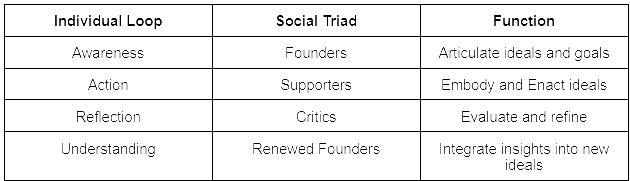
This symmetry explains why individual moral growth and societal moral evolution often mirror each other. When people cultivate awareness, act intentionally, reflect honestly, and integrate understanding, they strengthen the same capacities that sustain vibrant cultures. Conversely, when societies foster open critique, support creative action, and articulate shared ideals, they nurture the inner development of their members.
7. Synchronization, Desynchronization, Balance and Imbalance
Because the same feedback structure operates at both levels, the alignment — or misalignment — between them has profound consequences.
Synchronization: When individual ideals resonate with social ideals, when actions are supported by institutions, and when criticism is welcomed both internally and externally, individuals feel meaningfully connected to their culture. Social trust rises, cooperation flourishes, and both personal growth and collective progress accelerate.
Desynchronization: When ideals clash, actions are obstructed, or criticism is suppressed, individuals experience alienation, frustration, and cognitive dissonance. Societies stagnate or polarize. Desynchronization explains phenomena from interpersonal conflict to cultural anomie.
Understanding synchronization helps individuals and societies diagnose their condition. A society suffering from moral stagnation might discover a lack of critics. A person struggling with guilt might see that their actions no longer serve their ideals. In both cases, the same principle applies: restoring balance in the feedback system leads to renewal.
Reflective Humanism holds that both individuals and societies operate through nested feedback loops: the inner triad of values, actions, and self-reflection, and the social triad of founders, supporters, and critics.
When these loops align in rhythm (temporal synchronization) and in content (value synchronization), moral and cultural systems thrive. When they fall out of sync, dysfunction follows.
A. Temporal Synchronization and Desynchronization
Temporal synchronization means that reflection and adaptation keep pace with change. Individuals adjust their understanding as life evolves; societies revise their ideals and institutions as conditions shift.
When reflection moves too slowly relative to environmental or technological change, the system experiences temporal desynchronization — the reflective lag that produces confusion, rigidity, and eventual crisis.
Personal signs include burnout and moral fatigue; collective signs include bureaucratic inertia, policy failure, and cultural stagnation.
When reflection moves too fast—when criticism or novelty outpaces integration—instability and fragmentation emerge instead of renewal. The challenge is balance: reflection must neither freeze nor outrun life.
B. Value Synchronization and Desynchronization
Value synchronization refers to coherence between ideals and realities—between what people believe, what they do, and what their circumstances require.
When ideals evolve harmoniously with material and emotional needs, values serve life rather than restrain it.
When they diverge, value desynchronization sets in: individuals experience guilt, hypocrisy, or alienation, while societies face legitimacy crises and moral confusion.
Outdated ideals become hollow symbols; people conform outwardly but feel inwardly estranged.
Restoring value synchronization requires reflective recalibration—testing whether the values guiding action still correspond to lived experience and collective well-being.
C. Inner–Social Triadic Balance
The individual and social triads mirror one another:
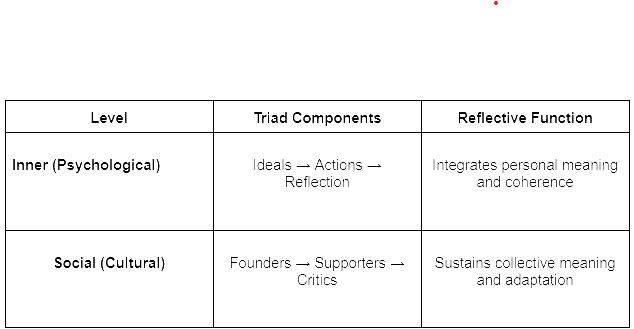
When the inner and social triads resonate, individuals feel aligned with their culture: their moral aspirations find recognition, their actions find support, and their doubts find dialogue.
When they drift apart—when societies demand what contradicts conscience, or when individuals lose trust in collective ideals—alienation and cynicism emerge.
A balanced society needs the same virtues as a balanced psyche:
Founders must listen as much as they proclaim.
Supporters must embody ideals without blind obedience.
Critics must question without destroying trust.
Each sustains the others’ reflection.
D. The Unified Principle of Reflective Coherence
Whether within a person or a civilization, moral health depends on reflective coherence — the simultaneous synchronization of:
Time (reflection keeps pace with change),
Value (ideals stay aligned with needs), and
Structure (the inner and social triads remain balanced).
When all three align, awareness, action, and reflection reinforce one another. The system becomes self-renewing — capable of continuous learning without collapse.
When any one fails, feedback breaks, reflection decays, and meaning erodes.
8. A Universal Structure of Adaptation
The reflective feedback loop is more than a moral tool — it is a fundamental structure of adaptation. It appears in the scientific method (hypothesis → experiment → analysis → theory), in democratic governance (debate → policy → oversight → reform), and even in biological evolution (variation → selection → feedback → adaptation). Its ubiquity suggests it reflects something deep about how complex systems — including human beings and their societies — learn, adapt, and evolve.
By making this structure conscious and intentional, Reflective Humanism transforms it from an unconscious pattern into a deliberate practice. Individuals can use the loop to guide personal development. Societies can institutionalize it to sustain moral progress. Together, they form a self-correcting system for aligning aspiration with reality — the essence of ethical life.
Summary:
The reflective feedback loop captures the internal dynamics of moral growth: awareness gives rise to action, action invites reflection, and reflection leads to understanding — which renews awareness and begins the cycle anew. This loop mirrors the social triad of founders, supporters, and critics, revealing a deep structural unity between the psyche and the polis. Synchronizing these processes is key to flourishing, while their breakdown explains alienation and decay. By consciously engaging this feedback system, individuals and societies alike can evolve their values with intention and wisdom.
V. The Triad at the Societal Scale: Cultural and Moral Evolution
1. Moral Evolution as the Selection of Values
Just as biological evolution operates through variation, selection, and inheritance, moral and cultural evolution unfolds through a process that is functionally analogous — but uniquely human. Values, norms, and institutions are not static artifacts; they compete, adapt, and transform across time as societies test them against the shifting conditions of reality. Reflective Humanism formalizes this process by showing how the triadic roles of founders, supporters, and critics drive a continuous cycle of cultural change. It is, in essence, a theory of natural selection for values — with the added possibility of conscious guidance.
Variation (Founders): New ideals, visions, and value-systems emerge from thinkers, prophets, reformers, artists, and movements.
Selection (Supporters): Those ideals are enacted, institutionalized, and tested in the real world by supporters — individuals, communities, and structures that embody them.
Feedback (Critics): Outcomes are evaluated, contradictions exposed, and ideals refined or rejected through critique.
Inheritance (Renewed Founders): Successful or transformed values become part of the cultural baseline, shaping the next generation’s aspirations.
Unlike genetic evolution, which is blind and undirected, this process can be conscious and deliberate. Human beings can design institutions that encourage variation, structure selection pressures, and institutionalize feedback. Reflective Humanism’s core insight is that the same feedback architecture that governs individual growth — awareness, action, reflection, understanding — also governs the evolution of civilizations.
2. The Triad in Historical Perspective: Cycles of Creation, Embodiment, and Renewal
a. The Axial Age and the Birth of Ethical Civilizations
Between roughly 800 and 200 BCE — a period Karl Jaspers called the Axial Age — multiple civilizations independently experienced bursts of ethical and philosophical creativity. Founders such as Confucius, Laozi, Buddha, Zarathustra, and the Hebrew prophets articulated transformative visions of justice, virtue, compassion, and cosmic order. These new ideals were embodied by supporters in the form of rituals, communities, and social norms, laying the groundwork for enduring cultural systems. Critics — often disciples themselves — emerged quickly, refining doctrines and questioning excesses. Mencius and Xunzi debated Confucian principles; early Buddhist councils wrestled with competing interpretations of the dharma.
This pattern — visionary articulation, institutional embodiment, critical refinement — repeated across regions, producing durable civilizational frameworks that still shape billions of lives. Reflective Humanism interprets this as a natural expression of the triadic cycle: human aspirations gave rise to ideals (founders), societies built structures around them (supporters), and reflection ensured their continual adaptation (critics).
b. Classical Antiquity: The Birth of Reasoned Critique
The Greek world offers a particularly clear illustration of the triad in action. Philosophers like Socrates, Plato, and Aristotle functioned as founders, articulating ideals of justice, virtue, and rational inquiry. These ideals were institutionalized through the polis, educational systems, and eventually the Hellenistic schools of philosophy. Yet Greek culture also nurtured critics: Socrates’ relentless questioning of Athenian norms exemplifies the critic’s role as an internal corrective, while Aristophanes’ satires reveal critique as a cultural force.
The same dynamic played out in Rome, where Stoic ideals articulated by figures such as Seneca and Marcus Aurelius were woven into legal and political institutions. Critics of excess — from republican reformers to Christian apologists — challenged entrenched norms, pushing Roman society toward transformation. Here too, values evolved through iterative cycles of articulation, embodiment, and critique.
c. The Christian and Islamic Worlds: Founders, Orthodoxy, and Renewal
Religious traditions offer some of the clearest examples of the triadic dynamic. Jesus, Muhammad, and early prophets articulated radical new visions of human destiny and moral obligation. Communities of believers built elaborate institutional structures to embody these teachings — churches, caliphates, legal codes, monastic orders. Over time, critics and reformers emerged within these traditions: theologians debated doctrine, mystics challenged formalism, and reformers protested corruption.
Periods of desynchronization — when supporters ossified into rigid orthodoxy or critics were suppressed — often led to stagnation or crisis. Yet critique eventually reasserted itself, revitalizing the tradition. The Protestant Reformation exemplifies this: Martin Luther’s criticism of church corruption and doctrinal distortion catalyzed a profound rearticulation of Christian ideals, reshaping Western civilization.
d. The Scientific Revolution: Critique as a Cultural Engine
The rise of modern science illustrates how deeply the triadic cycle structures human progress. Founders like Copernicus, Galileo, Kepler, and Newton articulated new visions of the cosmos grounded in observation and mathematical law. Their ideas were institutionalized by supporters — scientific societies, universities, and eventually state-funded research bodies — creating a durable structure for inquiry. Yet the vitality of science has always depended on critics: peer review, replication, and skepticism are institutionalized forms of critique that keep science self-correcting.
This institutionalization of the critic role transformed science into an enduring feedback system. The “natural selection of hypotheses” mirrored the selection of values, with successful ideas retained and refined while failed ones were discarded. It is no coincidence that science — perhaps humanity’s most successful knowledge system — embodies the reflective feedback loop more explicitly than any previous enterprise.
e. Revolutions and Rights Movements: Ideals as Adaptive Forces
The Enlightenment and subsequent democratic revolutions provide another vivid demonstration of the triad. Philosophers such as Locke, Rousseau, and Voltaire articulated ideals of liberty, equality, and reason (founders). Revolutionary assemblies and new constitutions embodied these ideals in political structures (supporters). Critics — abolitionists, suffragists, civil rights leaders — challenged the exclusion and hypocrisy embedded in early implementations, driving further refinement.
The civil rights movement in the United States shows the cycle in microcosm. The founding ideals of equality and liberty were institutionalized but unevenly realized. Critics like Frederick Douglass, W.E.B. Du Bois, and later Martin Luther King Jr. forced society to confront its contradictions. Their efforts yielded new laws, new norms, and a deeper (though still incomplete) understanding of what equality demands. This process illustrates how critique is not antagonism but the continuation of founding ideals by other means.
3. Scaling the Triad: From Families to Civilizations
The power of the triadic model lies in its scalability. The same underlying structure that explains religious reformations and scientific revolutions also governs small-scale human interactions, organizational cultures, economic paradigms, and even aesthetic movements. Once we recognize the founders–supporters–critics dynamic as a fundamental pattern of moral organization, it becomes possible to trace its operation everywhere human values evolve.
a. Interpersonal Dynamics: The Feedback Loop in Daily Life
Consider a seemingly trivial domestic conflict: a husband becomes frustrated that his wife is taking too long to get ready for an event. Beneath the surface of irritation, the triadic dynamic is at work.
The husband’s inner founder is his aspiration for punctuality and respect for shared commitments.
His supporter function manifests as actions — reminding, pacing, expressing frustration.
His inner critic (and hers) evaluates whether the response aligns with the ideal: is punctuality worth tension? Is his impatience fair?
Likewise, the wife’s founders may prioritize care in presentation or autonomy over her preparation time. Supporters (her behaviors) enact those ideals, and critics (internal reflection or external feedback) assess whether her priorities balance well with shared expectations.
The conflict represents a desynchronization of inner founders and supporters between two individuals. Resolution comes not from dominance but from reflection and realignment: new shared ideals (mutual respect, communication), new supportive actions (agreeing on timelines), and ongoing feedback. Even here, the feedback system operates as a small-scale engine of moral adaptation.
b. Organizational Life: Founders, Supporters, and Critics in Institutions
Corporations and organizations vividly express the triadic structure. A company begins with founders who articulate a mission — to democratize information, accelerate sustainable energy, or connect people. Supporters embody that vision: employees, managers, and operational systems execute the mission. Critics — internal auditors, regulators, customers, and even whistleblowers — evaluate performance and hold the system accountable.
Desynchronization explains common organizational crises. A startup may grow large and lose contact with its founding ideals (founders ossify), or bureaucracy may resist adaptation (supporters ossify), or dissent may be stifled (critics suppressed), leading to scandals or stagnation. Healthy organizations institutionalize the feedback cycle: they revisit mission statements, encourage internal critique, and adjust structures to new conditions.
Reflective Humanism offers a diagnostic tool here: by mapping where the triadic system is blocked, organizations can anticipate dysfunction before it manifests. Companies that institutionalize this cycle often innovate more effectively and sustain their cultures over time.
c. Economic Paradigms: Value Evolution at the Systemic Level
Even entire economic systems follow the same pattern. Founders — whether classical economists like Adam Smith or revolutionary thinkers like Karl Marx — articulate ideals about how wealth should be produced and distributed. Supporters enact those ideas through markets, governments, labor systems, and trade networks. Critics challenge inequities, inefficiencies, or contradictions, prompting reforms.
For example, the rise of industrial capitalism in the 18th and 19th centuries embodied Smithian ideals of free exchange and specialization. Critics from Marx to Keynes identified failures — exploitation, instability — prompting new institutions such as labor unions, social welfare systems, and central banking. Later critics, responding to environmental and social costs, inspired movements toward sustainability and stakeholder capitalism. The economic landscape evolves not by fiat but by the iterative feedback of the triadic cycle.
d. Artistic and Cultural Movements: Value Selection in Aesthetics
Art, too, evolves through this process. Founders introduce new visions — Renaissance humanism, Romanticism, modernism, postmodernism — each redefining what art is and means. Supporters — artists, patrons, institutions — bring those visions into being. Critics debate, challenge, and refine their assumptions, shaping future movements.
Modernism, for example, arose as a critique of realism and tradition, embodying new ideals of abstraction, innovation, and subjectivity. Postmodernism emerged as a critique of modernism’s universalizing tendencies, emphasizing plurality and context. Each cycle introduced new variation, tested it in the cultural arena, and retained what resonated — a direct analogue to natural selection for values.
e. Classes, Nations, and Civilizations: Macro-Scale Dynamics
The same principles govern large-scale social transformations. Class struggles, national movements, and intercultural conflicts often reflect competing founders articulating incompatible ideals. Supporters — states, classes, coalitions — embody these ideals in institutions and policies. Critics expose hypocrisies, injustices, or failures, driving either reform or revolution.
The French Revolution emerged from Enlightenment founders challenging monarchical ideals, supporters enacting republican structures, and critics refining them into constitutional democracy.
The Cold War was, in essence, a competition between rival value systems — liberal democracy and communism — each generating founders, supporters, and critics within and across societies.
Postcolonial movements saw new founders articulate ideals of sovereignty and identity, supporters build states and institutions, and critics challenge postcolonial inequalities and internal corruption.
Even wars can be seen as violent collisions of triads — clashes between incompatible value systems that cannot be reconciled through normal feedback processes. Peaceful transitions, by contrast, often arise when criticism leads to synthesis rather than annihilation.
4. Synchronization, Desynchronization, and Cultural Trajectories
The triadic model provides not only a descriptive framework but a diagnostic and predictive tool. The alignment — or misalignment — of founders, supporters, and critics determines whether societies flourish, stagnate, or collapse.
Synchronization: When ideals remain responsive to reality, when institutions embody them effectively, and when critique is free and constructive, societies experience dynamic equilibrium. Innovation, reform, and cultural vitality are continuous.
Partial Desynchronization: If one role dominates — founders ossifying into dogma, supporters prioritizing power over principle, or critics descending into nihilism — progress falters. Institutions persist but legitimacy erodes.
Total Breakdown: When feedback fails entirely — when critique is silenced, ideals are rigid, and institutions resist change — collapse often follows. Historical examples include the late Roman Empire, the ancien régime in France, and the Soviet Union.
This model also explains renewal: after collapse, new founders emerge, often from marginalized spaces, articulating ideals suited to new realities. The cycle begins anew.
5. Conscious Guidance: Reflective Humanism as a Steering Mechanism
If this triadic feedback system operates even when unrecognized, the promise of Reflective Humanism lies in making it conscious. Just as biological evolution became harnessable once humans understood genetics, so too can cultural and moral evolution be guided once its underlying structure is understood.
At the personal level, individuals can cultivate awareness of their inner founders, align actions with aspirations, and embrace criticism as a tool for growth.
At the institutional level, organizations can design mechanisms for continuous feedback, institutionalized critique, and periodic re-articulation of mission and values.
At the societal level, nations can embed the triad into their governance — fostering environments where ideals evolve through open dialogue, where institutions are accountable to their founding principles, and where critique is protected and valued.
Such conscious design could reduce cycles of violent revolution and ideological stagnation, replacing them with continuous, reflective evolution — a cultural analogue to the self-correcting nature of science.
6. Toward a Universal Framework of Cultural Change
From a family disagreement to a global movement, from a start-up company to a thousand-year civilization, the same pattern recurs: ideals arise (founders), they are enacted (supporters), they are critiqued (critics), and new ideals emerge. This structural symmetry suggests that moral and cultural evolution is not random but follows a recognizable pattern — a natural selection for values that can be consciously cultivated.
Reflective Humanism provides the language and method for doing so. By uniting individual reflection and social triads into a single feedback architecture, it explains why societies change, why they fail, and how they can flourish. More importantly, it offers a way to guide that evolution — to align human aspiration with action and critique in pursuit of a more just, meaningful, and adaptive world.
Summary:
The triadic model, operating at the societal scale, reveals moral and cultural evolution as a process akin to natural selection for values. Founders introduce variation, supporters embody and test it, critics refine or reject it, and successful ideals are inherited into the next cycle. This structure explains phenomena from family disputes to revolutions, from corporate culture to economic paradigms. Synchronization fosters flourishing, while desynchronization predicts stagnation or collapse. By making this process conscious, Reflective Humanism offers humanity a method to steer its own moral evolution deliberately, continuously, and wisely.
VI. Predictive and Explanatory Power (Part A1)
1. Predictive and Explanatory Power in Philosophy and Social Theory
Philosophical and social theories aim not only to interpret the world but also to explain why events unfold as they do and, ideally, to predict how they will unfold under certain conditions. A framework with strong explanatory power can reveal the deep structures and dynamics underlying complex phenomena. One with strong predictive power can anticipate likely patterns or outcomes based on those dynamics, even in new contexts.
For example, Darwinian evolution explains the diversity of species and predicts how populations will change under selective pressures. Marxism explains class conflict as the engine of historical change and predicts that capitalist societies will eventually face internal crises. Freud’s psychoanalysis explains human behavior through unconscious drives and predicts recurring conflicts within the psyche.
Most philosophical systems succeed at one of these tasks — explanation or prediction — but rarely at both, and even more rarely across multiple levels (individual, institutional, societal). Reflective Humanism aspires to this rare breadth. It explains how values, norms, and moral systems arise, evolve, and decay — and it predicts when they are likely to change or stagnate based on the state of the reflective feedback system.
2. Reflective Humanism’s Predictive Structure
The predictive power of Reflective Humanism arises from its core claim: that moral and cultural evolution is driven by a feedback system between individual reflection and the triadic social roles of founders, supporters, and critics.
This system generates a set of testable expectations:
Emergence of New Ideals: When existing values no longer align with human aspirations or material realities, new “founder” ideals will emerge.
Institutionalization: If these ideals resonate widely, “supporters” will create structures and norms to embody them.
Critical Tension: Over time, contradictions between ideals and realities will accumulate, prompting “critics” to challenge the system.
Adaptation or Collapse: If critique leads to renewal, the system evolves; if critique is suppressed or fails, stagnation or breakdown follows.
These cycles occur at all scales — in personal identity development, political revolutions, religious reformations, scientific paradigms, and corporate lifecycles. Thus, Reflective Humanism predicts not specific events but recurring patterns of change, crisis, and renewal.
3. Comparison I – Marxism and Reflective Humanism
Historical Materialism, developed by Karl Marx and Friedrich Engels, remains one of the most ambitious attempts to explain and predict historical change. It argues that the material base of society — the mode of production — shapes its superstructure (law, politics, ideology), and that class conflict arising from contradictions in the productive system drives historical transformation.
While Marxism and Reflective Humanism share a commitment to explaining large-scale social change, they diverge in fundamental ways.
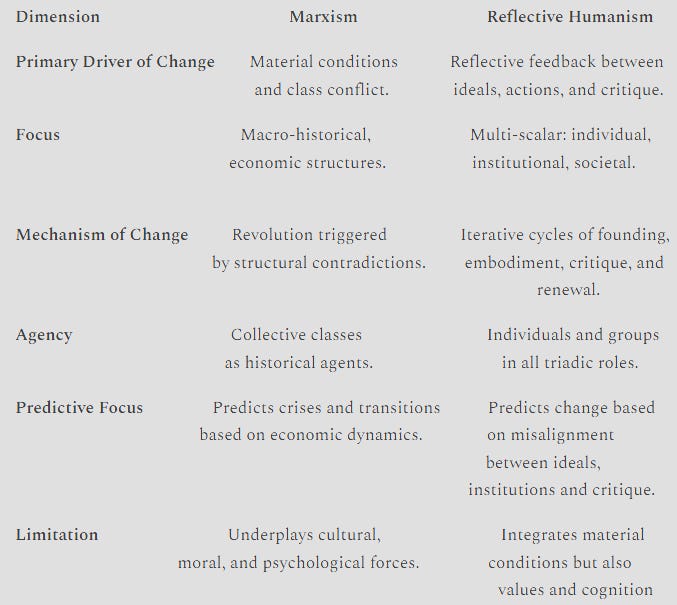
Strengths of Marxism: It offers a powerful account of why societies transform and highlights the central role of material conditions. It correctly predicts recurring tensions between production systems and social relations — e.g., feudalism giving way to capitalism.
Limitations: Marxism often reduces ideology and morality to reflections of material forces. It struggles to explain why similar material conditions can yield divergent moral systems, or why revolutions sometimes fail despite economic inequality. It also offers limited insight into micro-level phenomena like individual moral growth or organizational culture.
Reflective Humanism’s Contribution: It subsumes material conditions as one factor shaping the feedback cycle but refuses to reduce moral life to economics. Instead, it sees economic systems as supporters that embody particular ideals — and subject to critique when those ideals no longer resonate. This allows Reflective Humanism to explain revolutions (as misalignments between ideals, institutions, and critique) and reformist evolutions, cultural renaissances, and ideological shifts that Marxism overlooks.
It also predicts why revolutions sometimes stall: when new founders fail to articulate compelling ideals, or when critique devolves into destruction without synthesis, the feedback cycle breaks down and new orders fail to stabilize.
9. Concluding Analysis: Predictive Power as Conscious Cultural Evolution
The ultimate promise of Reflective Humanism is that it transforms what was once unconscious into something we can understand and guide. Where Marx saw material forces shaping ideology, Reflective Humanism shows how ideals shape and are shaped by material conditions through feedback. Where Freud revealed unconscious drives, Reflective Humanism reveals their iterative transformation through reflection. Where Kuhn described revolutions after they occurred, Reflective Humanism helps us anticipate and even orchestrate them.
It also predicts specific phenomena:
Alienation and Anomie: When founders and supporters fall out of alignment (ideals vs. institutions), individuals feel disconnection — predicting social unrest.
Ideological Stagnation: When critics are suppressed, systems ossify — predicting eventual crisis.
Moral Revolutions: When critique aligns with emerging ideals and supportive structures adapt, rapid cultural transformation follows.
Organizational Decline: When institutions embody outdated ideals or reject critique, they decay — a pattern seen in corporations, empires, and religions alike.
Perhaps most importantly, Reflective Humanism offers tools to shape these dynamics. By institutionalizing critique, cultivating spaces for new ideals, and consciously aligning individual reflection with social structures, societies can evolve continuously without catastrophic rupture.
This capacity — to explain, to predict, and to guide — is what elevates Reflective Humanism from an interesting theory to a potentially transformative one. It is not simply a philosophy about human flourishing; it is a method for bringing it about.
VI. Predictive and Explanatory Power (Part B1): Applied Predictive Power
1. From Explanation to Application
A theory achieves its highest value when it does not merely describe or predict but can guide action. Reflective Humanism, by revealing the feedback structure underlying moral and cultural evolution, offers such guidance. Its triadic model and reflective loop are not abstract constructs; they are practical tools for diagnosing misalignment, anticipating crises, and designing systems — from personal habits to governmental institutions — that are adaptive, resilient, and humane.
This section explores how the framework can be applied across three scales — individual, organizational, and societal — and how it can function as a kind of moral early-warning system. By consciously engaging the same processes that unconsciously drive history, humans can shift from being passengers of cultural evolution to co-authors of it.
2. Individual Level – Reflection as a Tool for Flourishing
a. Diagnosing Inner Misalignment
Individuals can use Reflective Humanism to understand their own psychological tensions and ethical struggles. Many experiences of anxiety, frustration, or alienation arise from misalignment between inner founders, supporters, and critics:
Founder misalignment: Aspirations that are vague, contradictory, or inherited without reflection lead to confusion and directionlessness.
Supporter misalignment: Actions that fail to embody one’s ideals cause guilt and cognitive dissonance.
Critic misalignment: A harsh or absent inner critic produces either paralyzing self-doubt or unexamined complacency.
By identifying which part of the triad is underdeveloped or in conflict, individuals can intervene precisely — refining their ideals, changing their behaviors, or cultivating healthier self-evaluation.
b. Structured Self-Reflection Practices
The reflective feedback loop provides a template for deliberate self-development. It can be practiced through regular exercises:
Awareness: Daily journaling to clarify values, motivations, and emotions.
Action: Setting small, intentional behaviors aligned with those values.
Reflection: Weekly review of successes, failures, and unexpected outcomes.
Understanding: Integrating insights into refined goals and principles.
This process turns ethical growth from a passive hope into an active discipline. It resembles Stoic askēsis or Buddhist mindfulness but is explicitly structured around feedback — making it more dynamic and iterative.
c. Navigating Conflict and Relationships
Reflective Humanism also illuminates interpersonal dynamics. Many conflicts arise when individuals’ inner triads are out of sync with one another. For example:
A partner values punctuality (founder) while another values thorough preparation.
Actions clash (supporters), and criticism escalates into resentment (critics).
Reflection and dialogue can generate new shared ideals (mutual respect, compromise), realigning the feedback loops.
This approach shifts conflict resolution from blame to structural understanding: disagreements are not moral failings but feedback signals indicating misalignment of ideals and enactments.
d. Personal Growth as Guided Evolution
At the deepest level, Reflective Humanism allows individuals to guide their own moral evolution. By consciously generating new ideals (inner founders), testing them through action (supporters), and evaluating them with honesty (critics), people can evolve their character with the same rigor that science evolves knowledge.
This transforms personal development from a reactive process into a deliberate one. The individual becomes an active participant in the natural selection of values, shaping their moral character rather than being shaped by circumstance alone.
3. Organizational Level – Designing Institutions That Think
Just as individuals benefit from reflective alignment, so do organizations. Whether corporations, schools, nonprofits, or governments, institutions are complex moral actors that embody and transmit values. Applying Reflective Humanism at this scale allows them to become more adaptive, innovative, and ethically coherent.
a. Founders: Clarifying Mission and Purpose
Every organization begins with a founding vision. Over time, however, missions become muddled, priorities drift, and original ideals are obscured. Periodic reflection on founding principles is essential to institutional health.
Organizations can formalize this process by:
Revisiting founding documents and purposes in regular strategic reviews.
Holding “mission audits” to assess whether current practices reflect original intentions.
Encouraging leadership to articulate evolving ideals in response to new realities.
For example, companies like Patagonia periodically revisit their founding commitment to environmental stewardship, adapting their mission to new challenges while preserving core ideals.
b. Supporters: Aligning Actions and Structures
Institutions embody ideals through their structures — policies, workflows, incentive systems. Misalignment occurs when these systems drift from the organization’s mission, often producing cynicism or ethical lapses.
Reflective Humanism offers diagnostic questions:
Do our policies still reflect our ideals?
Do incentives reward behaviors aligned with our mission?
Are there areas where our actions contradict our stated values?
Case example: After the 2008 financial crisis, several major banks undertook governance reforms precisely because their internal structures had drifted from stated principles of fiduciary responsibility. By realigning incentives and oversight with founding missions, they sought to restore trust and legitimacy.
c. Critics: Institutionalizing Feedback and Accountability
The critic role is often the weakest in organizations — and yet it is the most essential for longevity. Companies, governments, and nonprofits alike suffer when criticism is stifled or ignored.
To embed the critic function, institutions can:
Create independent review boards or ethics committees.
Encourage whistleblowing protections and internal dissent channels.
Incorporate regular stakeholder feedback and external audits.
A striking example is Toyota’s “andon cord” system, which empowers any assembly-line worker to halt production if they detect a defect. This institutionalized critic role — built directly into workflow — is a key reason Toyota maintains quality and adaptability over decades.
d. Predicting Organizational Decline and Renewal
The feedback model predicts when organizations are at risk of crisis:
Founder ossification: Mission statements that haven’t changed in decades despite new realities.
Supporter dominance: Bureaucratic inertia that prioritizes procedure over purpose.
Critic suppression: Cultures that punish dissent or ignore warning signs.
Conversely, organizations that periodically renew their ideals, realign their practices, and welcome critique are far more likely to innovate and endure. This predictive capacity makes Reflective Humanism a powerful tool not only for diagnosing problems but also for designing institutions that can think and evolve.
VI. Predictive and Explanatory Power (Part B2): Applied Predictive Power
4. Societal and Governmental Level – Feedback as Cultural Infrastructure
At the broadest scale, Reflective Humanism provides a framework for understanding how civilizations evolve and how governments can foster resilience. Societies thrive when their ideals (founders), institutions (supporters), and channels of critique (critics) remain in dynamic balance. They decline when this balance collapses.
Synchrony: A society whose founding ideals remain vital, whose institutions embody them effectively, and whose critics operate freely will experience stability and adaptability.
Desynchrony: If ideals ossify into dogma, if institutions become detached from their moral purpose, or if criticism is suppressed, stagnation and breakdown follow.
Governments and cultures can use this lens as a diagnostic tool. For instance:
Democracies periodically revitalize themselves through reforms, amendments, or social movements — a healthy feedback process.
Authoritarian regimes often suppress critics, leading to brittle institutions that appear stable but collapse rapidly under stress.
Reflective Humanism predicts these patterns and suggests remedies: create safe spaces for critique, ensure institutions remain tethered to ideals, and periodically renew founding visions.
5. Design Principles for Reflective Systems
How can societies and organizations deliberately build this model into their structures? Reflective Humanism suggests several design principles:
Institutionalized Founders – Ensure there are mechanisms for regularly articulating and revising shared ideals. This could take the form of constitutional conventions, educational curricula, or cultural forums.
Living Supporters – Design institutions not as static guardians of tradition but as adaptive embodiments of ideals. This requires flexibility in law, governance, and organizational design.
Protected Critics – Guarantee channels for critique that are free, independent, and valued. Journalists, academics, artists, and citizens must be empowered to question without fear.
Feedback Cycles – Create explicit processes where critique leads to rearticulated ideals, which then guide new structures. Without this loop, critique dissipates and renewal stalls.
Multi-Scale Synchrony – Align personal reflection, organizational governance, and societal feedback. For example, civic education can teach individuals how to reflect critically while also engaging in collective dialogue.
Together, these principles allow communities to transform the unconscious cycles of cultural evolution into conscious design.
6. Historical and Contemporary Illustrations
a. Historical Example – The Scientific Revolution
The rise of modern science illustrates the triad’s predictive structure. Founders (Copernicus, Galileo, Newton) articulated new ideals of empirical observation. Supporters institutionalized these methods in academies and journals. Critics refined and tested claims, ensuring errors did not ossify into dogma. Because all three roles were institutionalized, science became self-correcting and capable of sustained progress — unlike earlier knowledge systems that collapsed under rigidity.
b. Historical Example – The Civil Rights Movement
This movement exemplifies renewal through critique. The founding ideals of liberty and equality had been partially embodied in American institutions but remained inconsistently applied. Critics — leaders, activists, and communities — exposed the contradiction, forcing supporters (laws, courts, and political structures) to adapt. The movement showed how critique, when aligned with founding ideals, strengthens rather than destabilizes a society.
c. Contemporary Example – Democratic Resilience
Modern democracies can be understood as systems that explicitly institutionalize critique (free press, opposition parties, judicial review). When these mechanisms weaken, polarization and stagnation grow. When they function well, democracies demonstrate resilience, correcting themselves through cycles of reform. Reflective Humanism clarifies why this works: the critic role prevents dogmatism, and the loop ensures continual adaptation.
7. Toward Guided Cultural Evolution
The greatest promise of Reflective Humanism is that it transforms a largely unconscious process — the natural selection of values — into a conscious and deliberate practice.
Individually, people can use the reflective loop to evolve their character.
Organizationally, institutions can embed founders, supporters, and critics into their structures to remain adaptive.
Societally, governments and cultures can design systems that balance stability with renewal, avoiding both chaos and stagnation.
This does not require a wholesale reinvention of civilization. It requires an overlay: building reflective practices into existing institutions, education, and cultural life. Town halls, schools, media platforms, and legislatures can all function as spaces where ideals are articulated, embodied, and critiqued in an ongoing cycle.
In this sense, Reflective Humanism is not a replacement for religion, democracy, or science, but a meta-framework that strengthens them. It describes the hidden architecture they already depend on and makes it explicit, so that it can be cultivated intentionally.
8. Conclusion – Reflection as a Civic and Cultural Pillar
If widely adopted, Reflective Humanism could become a pillar of cultural life alongside government, education, and religion. Its predictive power allows us to recognize when ideals, institutions, and critique are falling out of alignment. Its prescriptive dimension offers methods for restoring balance. Its universality — scaling from personal habits to global systems — gives it unprecedented scope.
In short, Reflective Humanism turns philosophy into a practical tool: a method for guiding the evolution of values in ways that are adaptive, just, and humane. It offers not only a diagnosis of humanity’s moral challenges but also a way to build resilient cultures that continually renew themselves.
VII. Implications for Society and Civilization (Part 1)
1. The Stakes of the 21st Century: Fragmentation, Complexity, and the Search for Coherence
Humanity stands at a pivotal juncture. Never before have societies been so globally interconnected, technologically empowered, and materially capable — yet so morally fragmented, institutionally strained, and existentially uncertain. Rapid advances in science and communication have transformed how we live, but they have not resolved the deeper questions of how we should live.
Liberal democracies struggle with polarization and declining trust. Religious traditions face both revitalization and rejection in a secular age. Knowledge proliferates at unprecedented speed, yet wisdom — the capacity to orient knowledge toward human flourishing — remains scarce. Individuals, meanwhile, grapple with loneliness, purpose anxiety, and identity fragmentation in a world saturated with choice but thin in shared meaning.
These crises share a common root: the absence of a unifying framework that connects the inner lives of individuals with the evolving values of their societies. Modern institutions often operate as isolated silos — education develops skills without cultivating ethical reflection; politics adjudicates power without sustained dialogue about ends; technology advances capabilities without considering their moral direction.
Reflective Humanism addresses this fragmentation not by imposing a new ideology but by providing a method: a structure for continuous moral renewal that links individual consciousness and collective evolution. By grounding ethics in a feedback system of founders, supporters, and critics — and by making that system explicit and teachable — it offers a means to realign ideals, institutions, and critique in an era defined by rapid change.
2. Integration into Existing Pillars of Society
Reflective Humanism is not meant to replace the great cultural institutions humanity has built — democracy, education, religion, science — but to deepen and stabilize them. It functions as a meta-framework: a reflective structure that can be woven into existing systems to enhance their capacity for adaptation, coherence, and meaning.
a. Democracy – Embedding Reflection into Governance
Democracy is, in principle, a political embodiment of the reflective process: citizens articulate ideals (founders), institutions enact them (supporters), and public discourse critiques and revises them (critics). Yet many democracies have drifted into dysfunction as these roles fall out of alignment. Founding ideals become empty rhetoric, institutions become detached from public will, and criticism devolves into polarization rather than constructive refinement.
Reflective Humanism suggests methods to strengthen democratic life:
Structured Founding Renewal: Periodic review and reinterpretation of constitutional principles and civic ideals can ensure they remain vital and responsive to new realities.
Institutional Reflexivity: Government bodies can adopt mechanisms for continuous feedback, such as citizen assemblies, deliberative forums, and transparent evaluation of policies.
Constructive Critique: Public discourse can be reframed not as partisan combat but as a shared reflective enterprise, where opposition is valued as part of moral evolution rather than treated as a threat.
Some democratic innovations already hint at this model — participatory budgeting, citizens’ juries, and public ethics commissions all institutionalize aspects of the feedback loop. Reflective Humanism provides the philosophical foundation to unify these experiments into a coherent civic practice.
b. Education – Teaching Reflection as a Core Competence
Education has long been tasked with transmitting knowledge and cultivating civic virtue. Yet in many societies, it has become narrowly focused on technical skills and economic utility. Students learn how to analyze data but not how to reflect on values; they master information but not orientation.
Reflective Humanism proposes a deeper role for education: to teach individuals not just what to think, but how to reflect. This involves:
Triadic Literacy: Helping students identify founders (sources of ideals), supporters (embodied actions), and critics (voices of evaluation) both in society and within themselves.
Reflective Practice: Embedding structured reflection into curricula — journaling, dialogue, and collaborative moral inquiry — so that students internalize the feedback loop as a habit of mind.
Narrative Awareness: Teaching history and literature as evolving dialogues between ideals, institutions, and critique, rather than as static records of facts.
The result would be citizens capable not only of participating in democracy but of enriching it — individuals who approach moral disagreement as an opportunity for shared reflection rather than zero-sum conflict.
c. Religion and Culture – Renewal Without Dogma
Religious traditions historically served as powerful frameworks for meaning, offering shared ideals, embodied practices, and interpretive critique. Yet many now struggle to adapt to pluralism and scientific knowledge. Secular societies, meanwhile, often lack the depth of moral narrative and community that religions once provided.
Reflective Humanism offers a way to revitalize meaning without dogma. By treating founders, supporters, and critics as enduring functions rather than sacred figures, it allows religious communities to reinterpret their traditions dynamically — preserving their wisdom while remaining responsive to change.
It also opens space for secular cultures to reclaim the communal and existential functions of religion. Public rituals of reflection, shared narratives about ideals and critique, and spaces for ethical dialogue could provide meaning and belonging without requiring metaphysical belief. In this sense, Reflective Humanism can act as a bridge between secular and religious worldviews, grounding both in a shared human process.
d. Science and Knowledge – Ethics as an Integral Dimension
Modern science is one of humanity’s greatest achievements — a self-correcting enterprise built on variation, testing, and feedback. Yet science often operates in isolation from moral reflection, advancing capabilities without sufficient attention to consequences.
Reflective Humanism suggests that the scientific method itself is a special case of the reflective loop — but one that can be expanded to include ethical reflection. Scientific communities can consciously integrate the triadic structure:
Founders: Articulate not only new hypotheses but also the ethical principles that guide research.
Supporters: Design institutions and funding systems that embody those principles.
Critics: Incorporate ethical review and societal dialogue into the evaluative process, not as an afterthought but as a core component of inquiry.
By linking knowledge creation to reflective ethics, science can become a more holistic driver of human flourishing — one that not only explains the world but helps shape a wiser one.
VII. Implications for Society and Civilization (Part 2)
3. New Institutions: The Vision of the Reflective Commons
If the reflective feedback loop and triadic model capture a universal pattern in how individuals and societies evolve morally, then the logical next step is to build institutions that deliberately harness this pattern. Just as the scientific revolution institutionalized empirical inquiry into laboratories and academies, and democratic revolutions embedded political reflection into parliaments and courts, a society committed to reflective humanism would develop dedicated spaces where ideals, actions, and critique are brought into structured dialogue.
One plausible form this could take is what we might call the Reflective Commons — a new kind of civic and cultural institution devoted to cultivating reflection as a public practice. These would not be temples of dogma nor sterile policy think tanks, but living forums where individuals and communities consciously engage in the feedback cycle.
Their core functions might include:
Foundational Articulation: Hosting dialogues and collaborative processes where participants articulate shared values, principles, and visions for the future.
Supportive Embodiment: Coordinating initiatives, partnerships, and projects that attempt to enact those values in practical ways — from local social programs to institutional reforms.
Critical Reflection: Providing platforms for dissent, evaluation, and debate that continuously test assumptions, expose blind spots, and refine ideals.
Unlike traditional legislative chambers or academic institutions, the Reflective Commons would bridge moral reflection, civic participation, and cultural meaning-making. They could exist at multiple scales: neighborhood assemblies where citizens deliberate on local issues, city-level centers that host ongoing public dialogues, or international networks that facilitate global ethical reflection.
Such institutions could also cultivate personal reflection as a public virtue. Regular forums might invite individuals to share their evolving councils of “founders, supporters, and critics” — historical figures, mentors, movements, or ideas that shape their moral orientation — and explore how those influences translate into action. Over time, this could normalize reflection as a shared cultural practice, much as voting or public education became civic norms in earlier eras.
4. Cultural Transformation and Social Cohesion
Widespread adoption of reflective practices could profoundly reshape cultural life. At present, many societies are caught between two poles: dogmatism, where ideals harden into unquestioned orthodoxies, and relativism, where values dissolve into subjective preference. Reflective Humanism offers a third path: a culture in which values are held strongly but examined continuously, and where critique strengthens rather than fragments shared purpose.
Several key transformations could follow:
From Polarization to Productive Disagreement: As criticism becomes understood as a vital part of the feedback loop rather than an attack on identity, public discourse could shift from adversarial combat to collaborative inquiry.
From Alienation to Belonging: Participating in shared reflective practices — from small group dialogues to large civic forums — could fulfill deep social needs for meaning and connection, reducing the isolation and nihilism that often accompany secular modernity.
From Cultural Stagnation to Renewal: By institutionalizing the critic role and encouraging periodic rearticulation of ideals, societies could avoid the sclerosis that afflicts traditions unable to adapt. Cultural evolution would become continuous rather than crisis-driven.
These shifts would not eliminate conflict or disagreement — nor should they. But they would provide structures to channel disagreement into growth, transforming conflict from a destructive force into a generative one.
5. Implications for Governance and Global Cooperation
The same principles apply on the geopolitical stage. Many of humanity’s greatest challenges — climate change, inequality, technological disruption — stem not from a lack of knowledge but from failures of coordination, trust, and shared moral purpose. Reflective Humanism offers a way to cultivate that shared purpose without imposing uniformity.
Global Founders: Humanity can collaboratively articulate common values — such as sustainability, dignity, and justice — as guiding principles for planetary governance.
Global Supporters: International institutions, treaties, and collaborative projects can embody those values through action.
Global Critics: Transnational networks of scholars, journalists, activists, and citizens can evaluate progress, expose failures, and propose refinements.
This triadic process could form the ethical backbone of a more coherent global order — one that balances diversity with shared direction. It reframes international cooperation not as a zero-sum contest of interests but as a shared reflective project: humanity thinking together about its future.
6. Reflection and the Evolution of Values
At its most profound level, Reflective Humanism suggests that moral and cultural change obey a logic analogous to natural selection — but one that humans can now guide consciously. New ideals emerge, are enacted, and are tested by critique; those that prove adaptive and resonant spread and endure, while others fade. This has always been true, but historically the process has been blind, slow, and often violent.
By making the feedback structure explicit and institutionalizing it across scales, humanity can begin to steer its own value evolution — a deliberate moral evolution rather than one driven by accident or domination. This could mark a turning point in cultural history comparable to the birth of science: just as humanity learned to guide the evolution of knowledge through controlled experimentation, it could now guide the evolution of values through structured reflection.
7. Toward a Mature Civilization
The ultimate implication of Reflective Humanism is a vision of a mature civilization — one that has learned not only to harness energy, information, and matter, but to harness reflection itself. Such a civilization would integrate feedback processes into every domain of life:
In education, reflection would be taught as a foundational skill, as essential as literacy or numeracy.
In governance, institutions would continuously renew their legitimacy by cycling through articulation, embodiment, and critique.
In science and technology, ethical reflection would be built into discovery and deployment.
In culture, communities would sustain shared meaning not through rigid dogma but through ongoing dialogue.
In personal life, individuals would consciously evolve their values and character, linking their growth to the larger story of humanity.
This vision is not utopian in the sense of a static perfect state. It is utopian in the original sense of the term: a direction, a horizon that orients effort. A reflective civilization would still face conflict, uncertainty, and tragedy — but it would face them with tools equal to the task.
8. Conclusion – Reflection as Civilization’s Core Competence
From the individual striving to align their actions with their ideals, to the society grappling with the contradictions of its founding principles, the same structure recurs: awareness gives rise to ideals, action embodies them, critique tests them, and understanding refines them. Reflective Humanism reveals this structure not as a peripheral process but as the very heart of moral and cultural life.
To make that structure conscious — to embed it deliberately in our institutions, our practices, and our imaginations — is to give humanity a new capacity: the ability to evolve its values as intelligently as it evolves its tools. The Reflective Commons and similar institutions would mark a new stage in this journey, transforming reflection from a solitary habit into a shared civic virtue, and from a background process into a primary driver of history.
In this light, Reflective Humanism is more than a philosophical system. It is an invitation to build a civilization capable of knowing itself — one that can examine its deepest assumptions, renew its guiding principles, and adapt without losing its soul. It is a call to make reflection not a luxury of the few but a universal practice, woven into the fabric of daily life and the structure of society.
If humanity answers that call, the reflective feedback loop that once guided individual wisdom could become the mechanism of collective flourishing — the quiet engine behind a civilization that learns, grows, and thrives without end.